Forget Brandon Aiyuk — 49ers Could Trade a Young WR for Eagles’ $96 Million Star
San Francisco, California – December 18, 2025 — As the San Francisco 49ers begin shaping their long-term outlook following a turbulent season, the wide receiver position has emerged as one of the organization’s most pressing questions. Concerns about depth, long-term stability, and — most notably — the future of Brandon Aiyuk are forcing the franchise to explore more aggressive options moving forward.
The situation in San Francisco has become increasingly clear. Aiyuk’s relationship with the 49ers has deteriorated to the point that his 2026 guaranteed money was voided, making his departure after the 2025 season appear almost inevitable. With that reality in mind, the 49ers now face the possibility of entering 2026 without a true No. 1 receiver, while the rest of the position group remains filled with uncertainty.
At the same time, a separate but equally intriguing situation is unfolding in Philadelphia. Eagles All-Pro wide receiver A.J. Brown, the owner of a $96 million contract, has grown increasingly vocal about his frustration with his role in the team’s offense. While Brown has not formally requested a trade, his public comments and visible dissatisfaction have raised questions about his long-term fit within the Eagles’ system.
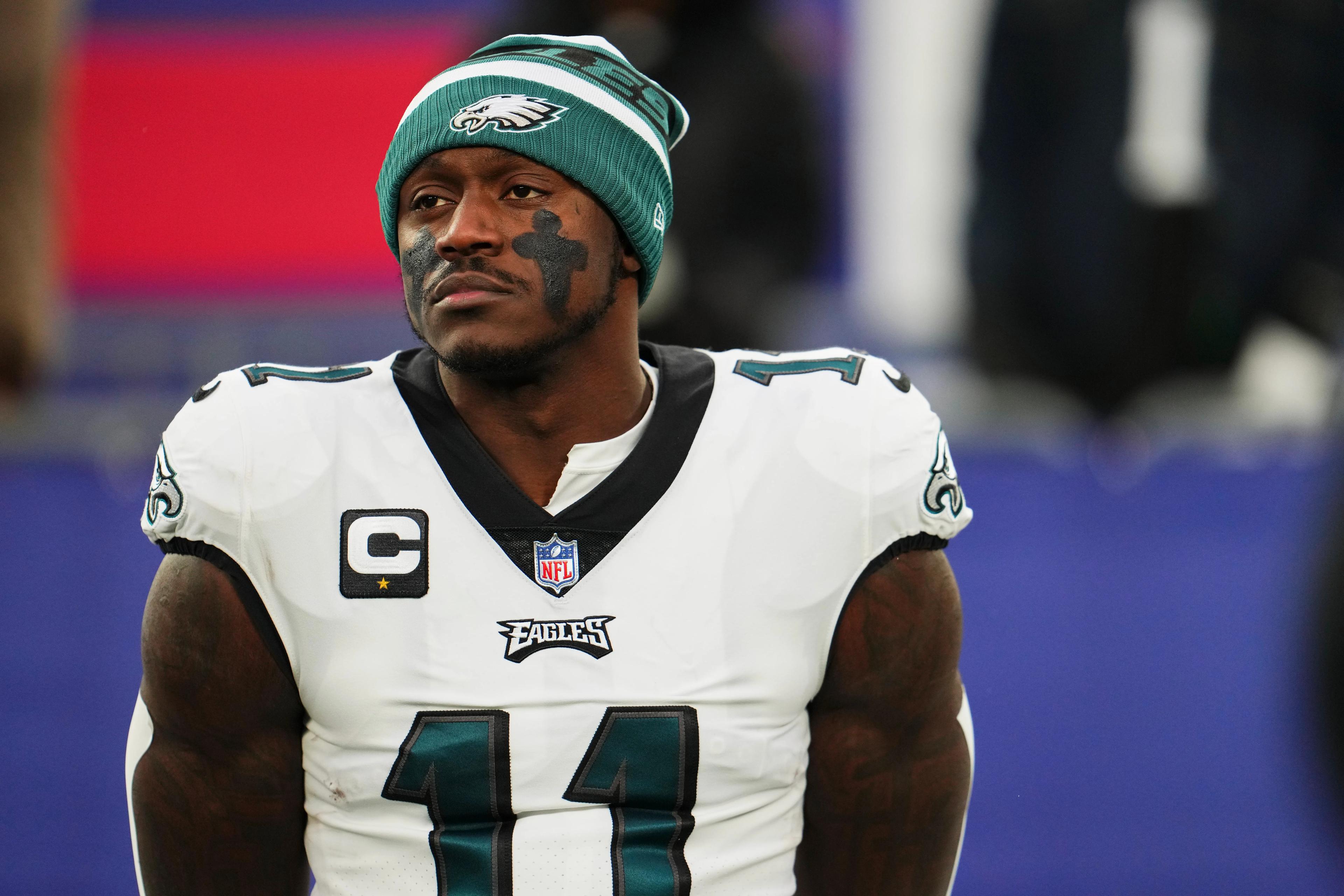
According to ESPN insider Jeremy Fowler, multiple league executives believe Philadelphia could seriously consider moving Brown during the 2026 offseason. Fowler noted that ongoing concerns surrounding Brown’s messaging and usage have placed strain on the Eagles’ locker room, and at 28 years old, Brown remains squarely in his prime and open to a new offensive environment.
That is where San Francisco enters the conversation as a natural landing spot. In Kyle Shanahan’s offense, wide receivers are maximized through route precision, spacing, and yards after the catch. Brown’s physicality, route-running ability, and experience in high-leverage situations would allow him to immediately step into a featured role — particularly as the 49ers prepare for life after Aiyuk.
From a roster standpoint, San Francisco’s wide receiver depth heading into 2026 remains shaky. Ricky Pearsall and Demarcus Robinson are under contract but have yet to establish themselves as consistent top-tier options. Younger receivers such as Jacob Cowing and Jordan Watkins remain developmental pieces, while Jauan Jennings and Kendrick Bourne are both projected to reach free agency unless re-signed. Compared to that group, Brown represents a clear and dramatic upgrade.
Financially, the deal is not as unrealistic as it may seem. While Brown’s contract carries a total value of $96 million, the acquiring team would take on approximately $50 million over the next two seasons, with an exit option in 2027. One scenario floated by league observers involves San Francisco sending a young receiver such as Jacob Cowing along with a future high draft pick in exchange for Brown.
There is, of course, inherent risk. Brown’s frustration stems in part from his experience with a successful Eagles franchise that recently won a Super Bowl. But that context also suggests his concerns may be rooted less in competitiveness and more in scheme fit. If there is an organization willing to bet on that distinction, the 49ers — firmly in win-now mode under Shanahan — may be prepared to take that chance.
For San Francisco, forgetting Brandon Aiyuk may no longer be a matter of emotion but necessity. With the franchise actively seeking its next alpha receiver, A.J. Brown represents a potential cornerstone for the next phase of the 49ers’ offense — should he truly become available.
May You Like
From Unforgettable Moments to Eternal Glory, Roger Craig Takes His Place Among Football Immortals

Latest Posts

Popular Posts